The trajectory of the human lifespan has traditionally been viewed as a fixed arc, as Benjamin Franklin said – Our new Constitution is now established, and has an appearance that promises permanency; but in this world nothing can be said to be certain, except death and taxes.
We are born, we age, and we die. To challenge this sequence is to challenge the definition of the species itself. Yet a new political and scientific force has emerged to do exactly that. They are not asking for better healthcare, instead they are asserting a fundamental right to abolish biological limits. It seems unlike prior loose groupings of anti-aging advocates like that of the entrepreneur Bryan Johnson, a semi-coherent ideology of Vitalism is forming out of the wreckage of competing ideals, and it is worthy of some note considering its increasing influence in medical and political affairs.
The Vitalist’s proposition allows for no negotiation, no nuance, and no acceptance of the natural order. According to the Vitalists, death is not a stage of life, as they advocate to people, who even likes death? As Vitalist founder Nathan Cheng told to MIT Technology Review, “If you believe that life is good and there’s inherent moral value to life, it stands to reason that the ultimate logical conclusion here is that we should try to extend lifespan indefinitely.”
Vitalism, as defined by founders Nathan Cheng and Adam Gries, is distinct from the historical concept of the same name. Unlike alternative medicine linked to spiritual identities, this particular Vitalism believes that if life is the standard of value, and health is the vehicle of life, then the cessation of life is the ultimate negation of value. Therefore, humanity has a rational imperative to use every resource available to prevent that cessation indefinitely.
This logic serves as the foundation for the Vitalist Declaration. This five-point manifesto governs the movement. It demands that adherents view aging not as a biological inevitability but as the “primary agent” of humanity’s core problem. It requires a commitment to halt aging through technology and critically, it reframes the pursuit of immortality as a morally justifiable thing that extends further than selfish desire. At least in theory.
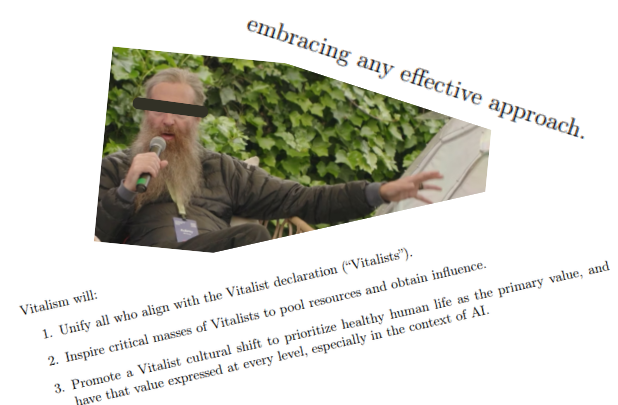
A graph included in the Vitalist Manifesto.

- Life and health are good. Death is humanity’s core problem, and aging its primary agent.
- Aging causes immense suffering, and obviating it is scientifically plausible.
- Humanity should apply the necessary resources to reach freedom from aging as soon as possible.
- I will work on or support others to work on reaching unlimited healthy human lifespan.
- I will carry the messages against aging and death.
The branding appears to be intentional, as we are full aware that terms like “anti-aging” have been overrun by cosmetics sellers and quacks, and appears to position itself as an ideology, more of a cousin of “Transhumanism”, that is, the philosophical and scientific movement that advocates the use of current and emerging technologies—such as genetic engineering, cryonics, artificial intelligence (AI), and nanotechnology, to augment human capabilities and improve the human condition. (Notably, a Transhumanist political party already exists in the United States.)
Adam Gries, a tech entrepreneur who approaches the problem of death with the same logic used to short markets, estimates that Vitalism needs to recruit only 3 percent to 4 percent of society to succeed.
The strategy, per MIT Technology Review, focuses on “high-leverage” individuals. The movement is actively recruiting those with a net worth exceeding $10 million alongside influential academics and biotech executives. Vitalists argue that shifting capital toward radical life extension could yield the technology required to halt biological time.
To facilitate this, the movement has established infrastructure. The Vitalism International Foundation acts as a central hub. It certifies biotech companies that align with their “hardcore” mission. This certification signals to investors which organizations are working on marginal health improvements and which, like Shift Bioscience or Tomorrow Bio, are engineering the biological hardware to reverse aging.
The movement began in the experimental jurisdictions of the crypto-wealthy. Gatherings at “pop-up cities” like Zuzalu in Montenegro and Vitalia in Honduras served as incubators. There, outside the reach of the FDA, enthusiasts discussed gene therapies and biohacking in environments that prioritized regulatory arbitrage.
However, the ambition has outgrown the island resort. The Vitalists have turned their attention to the United States’ legal system itself. Vitalist figures supported the passage of legislation in Montana allowing clinics to sell experimental treatments after preliminary safety testing, bypassing the lengthy efficacy trials required by federal agencies. Furthermore, they appear to be emulating the Free State Project in New Hampshire, essentially proposing that Vitalists (or more broadly, longevity enthusiasts) do the same thing with Rhode Island, with a quote from Cheng being “Five to ten thousand people—that’s all we need.”
The political wind appears to be shifting further, as figures like Jim O’Neill, a longtime longevity enthusiast and associate of Peter Thiel, have moved into high-ranking positions within the Department of Health and Human Services. O’Neill, who previously served on the board of the Seasteading Institute, represents the exact demographic Vitalism targets. He is ideologically aligned, politically connected, and positioned to direct billions in federal funding.
The natural alignment between the Vitalist movement and American Libertarianism is obvious on the surface. Both factions view the current regulatory state as an impediment to human potential. Both harbor a deep suspicion of centralized bureaucracies that delay progress in the name of safety. When a Vitalist argues that a terminal patient should have the absolute right to inject an experimental gene therapy, they are speaking the language of self-ownership.
This may fracture the moment the conversation shifts from deregulation to implementation. The Vitalist goal is not merely the freedom to try unproven medicines. It is the industrial-scale defeat of death. That objective requires a mobilization of resources that historically resembles the very statism libertarians despise, though it doesn’t necessarily imply state power must be used to mandate Vitalist successes upon the general population. At least, both would agree on principle that by demanding years of efficacy trials, the state currently effectively prohibits the deployment of therapies that might save lives today.
Indeed, a form of Vitalism seems fully compatible with Libertarianism, as under the Libertarian framework, capital will flow to the most effective treatments (one hopes, though the author may personally disagree on this.) unconstrained by intense regulatory regimes if given informed consent by the user. Under the Vitalist view that complies with free-market Libertarianism, therefore, the market will solve the problem of aging just as it solved the problem of global logistics.
A schism may arise, however, when the scope of the ambition is fully realized. Longevity enthusiasts frequently invokes the Apollo program and the Manhattan Project as templates for what can be achieved. These were not products of the free market. They were massive, taxpayer-funded initiatives driven by state coercion and centralized planning, and to boot, unlike the Apollo program, Vitalists see disagreeing on the principles of Vitalism as immorality.
A true war on death requires basic science on a scale that venture capital rarely funds. It demands infrastructure and data coordination that private competitors are unlikely to share. If Vitalism follows the logic of its own “moral imperative,” it inevitably drifts toward biomedical statism. Indeed, already on the whitepaper, to quote in verbatism –
Our mission is to end aging and offer freedom from death to all… For this to be achieved in our lifetimes, we need to make freedom from aging and death humanity’s #1 priority. Only then will it be possible to re-allocate humanity’s resources…
If aging is a crisis comparable to a world war, then Vitalists may argue the government is morally obligated to conscript wealth to fight it. The call for a “longevity state” or a commitment of 1 percent of GDP is as much as a request for government to step back. as it is a demand for government powers to mobilize the 1 percent of GDP.
Furthermore, Libertarianism is rooted in the basic principle of “you can do whatever you want provided you do not hurt others.” Vitalism complicates this. If society commits that the ultimate moral victory is the indefinite extension of life, the collective cost of unhealthy behavior becomes morally unsustainable. In a world where the state is dedicated to immortalizing its citizens, the freedom to smoke or consume sugar becomes a form of sabotage, which then leads to the very much current debates around sugar taxes and anti-smoking laws.
The logical endpoint of a state dedicated to the eradication of death is not necessarily a libertine paradise. It could just as easily resemble a sanitary authoritarianism. Under a strict Vitalist moral code, the refusal to optimize one’s health is a refusal to participate in the collective project. The motto “Live Free or Die” is arguably questionably compatible, at best, with a philosophy that views death as an unacceptable outcome.
The movement is currently operating under a big tent. It shelters the crypto-anarchist who wants to build a floating lab in international waters and the DC lobbyist pushing for federal research grants. They are united by the immediate hurdle of the FDA.
If the hurdle is cleared, one can easily imagine the unity dissolving. One faction may agree with the Libertarian argument, while the other faction may pursue the capture of the American apparatus. They will argue that the federal government exists to protect its citizens, and that failing to protect them from aging is a dereliction of duty. A credible extension of Vitalism is to seek to turn the Department of Health and Human Services into a war room, to co-opt statist power to their own advantage to achieve the ideals of Vitalism.
Therefore, the conclusion may be that the Vitalism is an ideology in flux, that currently is consisted of and allied with Libertarians to defy the current medical establishment and state power to enforce them, but one that its core tenets may eventually demand total compliance fundamentally incompatible with Libertarianism. They are willing to break the FDA to save lives, but the question will linger on whether they are willing to break the concept of liberty to save lives for eternity.
Leave a Reply