Update, June 4: You can still access the log-in page, and potentially the mailbox, via the address https://webmail.lycos.com/. For those shut out of Lycos Mail, I suggest that it’s worth a try.
Update, June 25: Lycos has clarified https://webmail.lycos.com/ is active.
For nearly thirty years, Lycos occupied a strange corner of internet history. It started as a search engine project in the early web era and grew into a portal packed with hosting services, personal websites, and email. Lycos launched its email service in October 1997, at a time when having an email address still felt novel rather than mandatory. At the olden times of 1997, they had partnered with USA.NET (NetAddress) to offer a co-branded free email service to its portal users, before ditching it in favor of their newly acquired proprietary platform (MailCity) in 1998.For many users, an @lycos.com address became their first online identity, one that survived the dial-up years, broadband adoption, smartphones, and even the rise of the AI era.
Now that chapter appears to be ending. While services do shut down all the time, the problem is how it happened, that is almost no communication, confusion, and a migration process that seems quite confounding at best.
Closing an email platform is unfortunately not like retiring a social network or a messaging app. An email address sits at the center of a person’s digital life. It is, most certainly, connected to banks, healthcare providers, government services, online shopping accounts, subscriptions, social media profiles, and years, sometimes decades, of personal correspondence. When major providers discontinue a service, they normally spend months warning users through repeated emails, account notifications, and clearly documented migration plans, which at least Excite Mail, another mail service from forever ago, at least had the decency to do in 2021 under IAC. (Somehow, despite the death of Ask.com, the Excite.com website herself still appears to be up.)
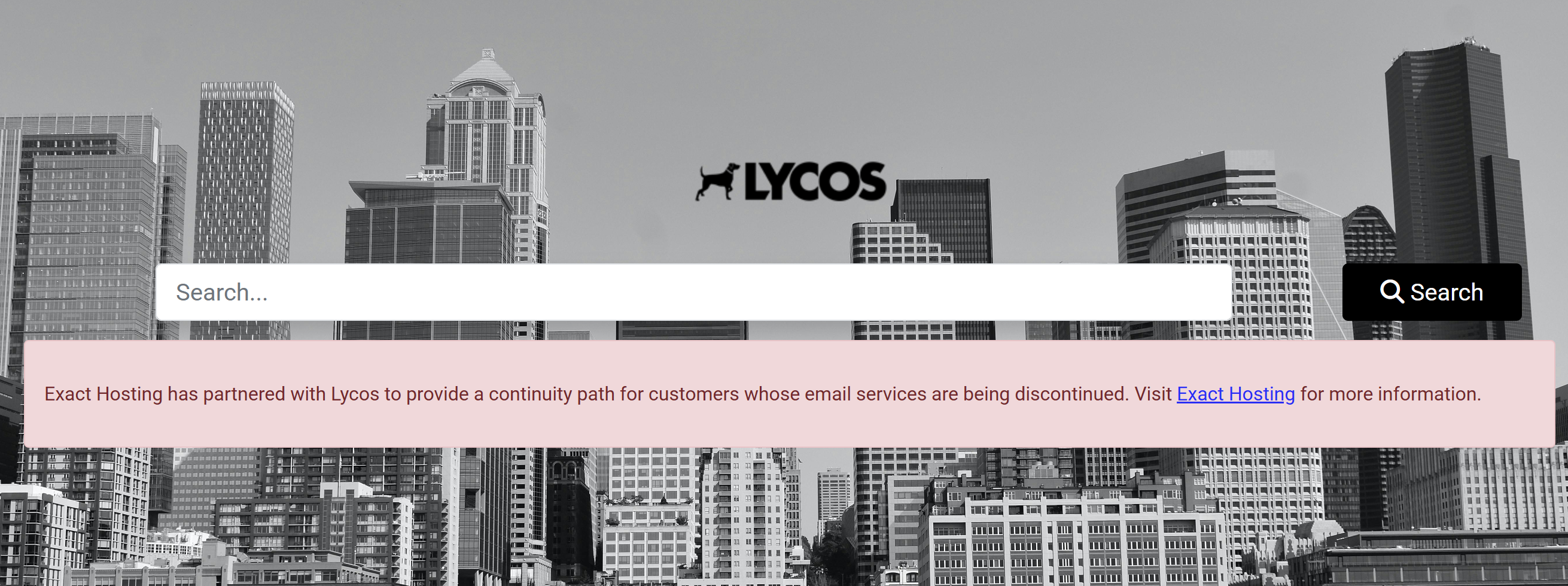
That does not appear to be what happened here. Instead, users began reporting connection failures. Many assumed Lycos was suffering another temporary outage, something long-time users had already become familiar with after years of intermittent reliability problems and poor communication. Eventually, on the Lycos website, one could find a small red notice stating:
“Exact Hosting has partnered with Lycos to provide a continuity path for customers whose email services are being discontinued. Visit Exact Hosting for more information.”
That was effectively the entire explanation, with no detailed timeline at all and no public breakdown of what services were ending, no clear statement about whether @lycos.com addresses would survive, simply a brief notice and a link to a third-party provider. The red-box message sent users to Exact Hosting, which had apparently been contracted to assist with data recovery and migration.
The problem was that Lycos never clearly explained what Exact Hosting was actually offering. You could justifiably assume they were simply moving their existing @lycos.com mailbox to new infrastructure. That seemed like the obvious interpretation. So when they reached the Exact Hosting signup process and were asked to choose a domain name, they entered “lycos.com” and lo and behold, the system rejected it. People may obviously conclude the migration process was broken, misleading, or outright fraudulent.
It does appear, given their own explanation, that the continuity program was never designed to preserve @lycos.com addresses. Those addresses are seemingly finished and cannot be transferred to another provider. What Exact Hosting appears to be offering is a mailbox recovery service rather than a mailbox continuation service.
To recover their data, Excite Hosting says that you must:
- Accept that the original @lycos.com address is no longer viable.
- Register a completely new custom domain.
- Purchase a hosting plan attached to that domain.
- Contact Exact Hosting support after setup is complete.
- Verify ownership of the former Lycos account.
- Have technicians manually copy mail folders, contacts, and historical data from the old Lycos infrastructure into the newly created mailbox.
Clearly, if users had received clear advance notice while the service was still operational, many could have migrated on their own. They could have downloaded archives, exported contacts, updated account credentials, enabled forwarding, and moved to Gmail, Outlook, Yahoo Mail, AOL, or any number of alternatives. Instead, many encountered a dead or failing service first and only learned about the migration path afterward which requires billing, and seems to be an exciting opportunity for Excite Hosting in question, who now gets to receive numerous paid hosting plans from former Lycos users, which had already paid for their email from Lycos Inc. A brilliant situation indeed, as the recovery has become dependent on whatever options remain available through the provider or its designated partner. For many people, that now appears to mean paying for a hosting plan simply to retrieve data they previously could have exported themselves.
For a service that carried people’s digital identities for decades, a small red notice saying the service was being “discontinued” after thirty years of service does seem like something of an utterly depressing ending to this treasure of Web 1.0 history. Rest in peace, Lycos Mail.
Update, June 5: You can still access the log-in page, and potentially the mailbox, via the address https://webmail.lycos.com/.


Leave a Reply